Showing posts with label Astronomy. Show all posts

Wednesday, December 19, 2007

Could this be the first solar activity of Cycle 24? I hope so!


The solar physics community is abuzz this week. No, there haven't been any great eruptions or solar storms. The source of the excitement is a modest knot of magnetism that popped over the sun's eastern limb on Dec. 11th, pictured below in a pair of images from the orbiting Solar and Heliospheric Observatory (SOHO).

It may not look like much, but "this patch of magnetism could be a sign of the next solar cycle," says solar physicist David Hathaway of the Marshall Space Flight Center. For more than a year, the sun has been experiencing a lull in activity, marking the end of Solar Cycle 23, which peaked with many furious storms in 2000--2003.

"Solar minimum is upon us," he says.


Above: From SOHO, a UV-wavelength image of the sun and a map showing positive (white) and negative (black) magnetic polarities. The new high-latitude active region is magnetically reversed, marking it as a harbinger of a new solar cycle.

The big question now is, when will the next solar cycle begin? It could be starting now! "New solar cycles always begin with a high-latitude, reversed polarity sunspot," explains Hathaway. "Reversed polarity " means a sunspot with opposite magnetic polarity compared to sunspots from the previous solar cycle. "High-latitude" refers to the sun's grid of latitude and longitude. Old cycle spots congregate near the sun's equator. New cycle spots appear higher, around 25 or 30 degrees latitude. The region that appeared on Dec. 11th fits both these criteria. It is high latitude (24 degrees N) and magnetically reversed.

Just one problem: There is no sunspot. So far the region is just a bright knot of magnetic fields. If, however, these fields coalesce into a dark sunspot, scientists are ready to announce that Solar Cycle 24 has officially begun. Many forecasters believe Solar Cycle 24 will be big and intense. Peaking in 2011 or 2012, the cycle to come could have significant impacts on telecommunications, air traffic, power grids and GPS systems. (And don't forget the Northern Lights!) In this age of satellites and cell phones, the next solar cycle could make itself felt as never before.
The furious storms won't start right away, however. Solar cycles usually take a few years to build to a frenzy and Cycle 24 will be no exception. "We still have some quiet times ahead," says Hathaway. Meanwhile, all eyes are on a promising little active region. Will it become the first sunspot of a new solar cycle?
Stay tuned!

Monday, December 3, 2007

Geminid Meteor Shower This Week!! Go outside and look up!!

Mark your calendar: The best meteor shower of 2007 peaks on Friday, December 14th.
"It's the Geminid meteor shower," says NASA astronomer Bill Cooke of the Marshall Space Flight Center. "Start watching on Thursday evening, Dec. 13th, around 10 pm local time," he advises. "At first you might not see very many meteors—but be patient. The show really heats up after midnight and by dawn on Friday, Dec. 14th, there could be dozens of bright meteors per hour streaking across the sky."

The Geminids are not ordinary meteors. While most meteor showers come from comets, Geminids come from an asteroid—a near-Earth object named 3200 Phaethon. How does an asteroid make a meteor shower? Comets do it by evaporating. When a comet flies close to the sun, intense heat vaporizes the comet’s "dirty ice" resulting in high-speed jets of comet dust that spew into interplanetary space. When a speck of this comet dust hits Earth's atmosphere traveling ~100,000 mph, it disintegrates in a bright flash of light—a meteor! Asteroids, on the other hand, don't normally spew dust into space—and therein lies the mystery. Where did Phaethon's meteoroids come from? One possibility is a collision. Maybe it bumped against another asteroid. A collision could have created a cloud of dust and rock that follows Phaethon around in its orbit. Such collisions, however, are not very likely.

If this scenario is correct, Phaethon-the-comet may have produced many rich streams of dust that spent hundreds or thousands of years drifting toward Earth until the first Geminid meteors appeared during the US Civil War. Since then, Geminids have been a regular shower peaking every year in mid-December.


Thursday, September 27, 2007

Get to know your friend, The Sun!

Whoa! We're up to 19 days with NO sunspots on the sun! WTF? You can thank the stupid solar minimum.

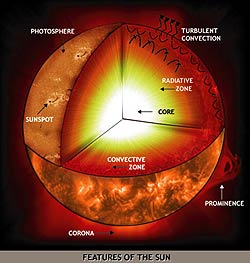
Now, because we don't have fancy-pants sunspot activity to distract us, we can focus on other cool stuff about our friend, The Sun. You may have heard that it takes light approximately 8 minutes to travel from the Sun to the Earth, yes? Well, light is generated by fusion deep inside the sun's core. How long does it take light to escape from the sun's core?

How does 10,000-100,000 years sound to ya? It's true!

Check out this nifty NASA article about it. From http://sunearthday.nasa.gov

Sunlight is produced through nuclear reactions in the sun's core. Originally born as energetic gamma rays, after billions of collisions with matter, this radiation reaches the surface and escapes into space. How old is sunlight by the time it reaches the surface?
Most textbooks say that it takes light between 100,000 years and 50 million years to escape. You would be surprised to know that this simple, and very popular, question seems to be without a firm answer! The reason has a lot to do with the assumptions that textbook authors use in making the calculation. Most astronomers are also not particularly interested in a high-accuracy answer, so they tend not to bother doing the tedious calculation exactly. It is actually a very complex problem in physics!

Once a photon of light is born, it travels at a speed of 300,000 km/sec until it collides with a charged particle and is diverted in another direction. Because the density of the sun decreases by tens of thousands of times from its lead-dense core to its tenuous photosphere, the typical distance a photon can travel between charged particles changes from 0.01 cm at the core to 0.3 cm near the surface. As a comparison, most back-of-the-envelope estimates assume that the sun's interior has a constant density and that the 'free path' distance for the photon is about one centimeter. It is these estimates that find their way into many popular astronomy textbooks.

Once you know, or assume, a typical distance between collisions, you also have to figure out how many steps the photon has to take to travel from the core to the surface. This is called the Random Walk Problem. The answer is that, if you take a sequence of N random steps, each for example of one meter length, the distance you travel from the starting point will be the square-root of N. After 100 random steps you will travel about 10 meters, but it will take 10,000 steps to travel 100 meters, and one million steps to travel about one kilometer, and so on. Because the density of the sun changes from the core to the surface, it is common to represent the interior of the sun as a collection of nested shells of matter, each with a typical average density. You then calculate how many steps it takes for a photon to travel through each shell. During each step, the photon travels at the speed of light so you can calculate the time required for each step. By multiplying this by the number of steps taken, you can calculate how long it takes the photon to traverse each shell, and then add up all the times for the other shells.


When this random walk process is applied to the interior of the sun, and an accurate model of the solar interior is used, most answers for the age of sunlight come out to be between 10,000 and 170,000 years. Rarely do you get answers greater than a million years unless you have made a serious error! Why do you still see these erroneous estimates of '10 million years' still being used? Because textbook authors and editors do not bother to actually make the correct calculation themselves, and rely on older published answers from similar textbooks.

Cool shit, eh?
Katy... out!

Tuesday, August 21, 2007

Where will you be 10 years from now?

It doesn't really matter where in the lower 48 states you are on August 21, 2017... as long as you are there looking up! Ten years from today there will be a solar eclipse across North America!!! Depending on where you are, you will see a partial or total solar eclipse. If I am anything like I am today, I'm guessing I will be out there with my solar telescope having a big party. See you in ten years!

Monday, August 20, 2007

The Cool Stuff Katy Saw


I realized that I need to start logging all the cool stuff I see in the night sky with the telescope (or in some cases without...). I had the telescope out Saturday and Sunday night this weekend, and I don't want to forget the cool nighttime objects. So here is the first installment of "The Cool Stuff Katy Saw".


Here is a list and some descriptions of things I've seen since purchasing my telescope in March 2007.


  • Saturn. Could see the rings and it looked fake, like an orange sticker.

  • The Moon. Can easily see small craters and texture along the rim of the moon's surface from craters and mountains. Also noted last night, that along the edge of the shadow, it appears that there are more craters. However, my uncle and I concluded that it's only because the shadows are longer the closer they get to the edge of the darkness (just like on Earth approaching sundown). The craters appear more numerous there.

  • The Sun. The real reason I bought the telescope in the first place. 2007 has not been very active because we are just coming out of the solar minimum. I've got high hopes for next summer. Solar maximum is due in 2011, though. Horrible timing for me! With my Solar Continuum Filter, I can see some granulation on the surface of the sun.

  • Venus. Bright and fairly blurry.

  • Mars. Red and fairly blurry.

  • Jupiter and four moons. Definitely impressive. Could see cloud bands on Jupiter, but no red spot as of yet. Four moons are usually visible. Sometimes only three because one is in front of or behind the planet.

  • Uranus. First sighting on 8/18. Not impressive because my telescope isn't that nice! Blue dot.

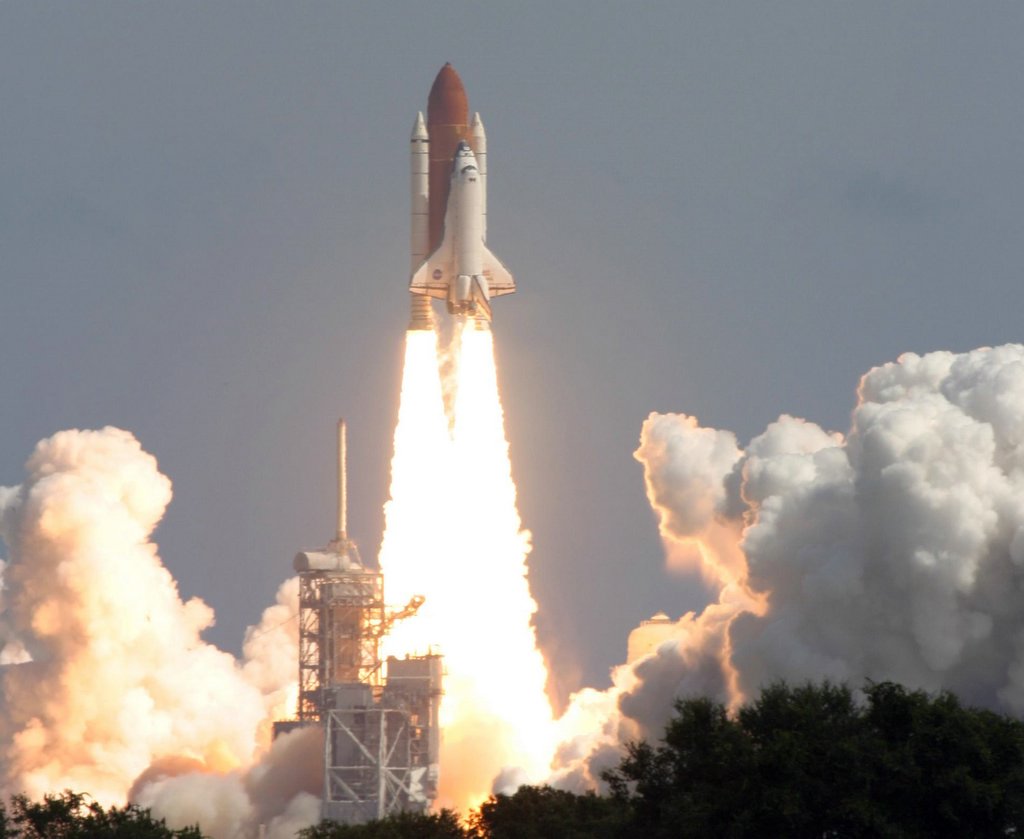
  • ISS and Space Shuttle Atlantis (mid July '07 I think). Saw the ISS and Atlantis two night before the Atlantis returned to Earth. It was especially cool because the shuttle was doing de-orbit burns. Very impressive!

  • ISS and Space Shuttle Endeavour (8/18 and 8/19). On Saturday 8/18, the two were still docked and floated overhead around 8:50pm. Very bright! On Sunday 8/19, the shuttle had undocked from the ISS, and the two trained across the sky around 9:15pm. That was amazing to see the two gliding over together. They got about 2/3 of the way across the sky when they disappeared... out of the sunlight. One more sighting due TONIGHT Monday August 20th. If you are in the Boston area, look up at 8pm. If you are elsewhere, go to http://spaceflight.nasa.gov/realdata/sightings/ and plug in your location.

  • The Double Cluster. Really cool! Two groups of stars next to each other. Cannot see the clusters with the naked eye!

  • The Butterfly Cluster. Also very cool! The cluster of stars resembles the outline of a butterfly.

  • Dumbbell Nebula. Blurry, but cool to know what you're looking at!

  • Andromeda Galaxy. Again, blurry, but cool!

  • Ring Nebula. Wicked awesome. Very faint, but you can definitely make out the ring shape.

  • Random meteor. While aligning the telescope on 8/18, had my eye on Altair, getting it centered, when a meteor streaked across the telescope view!!

Thursday, August 9, 2007

Haha!


Astronomy Geek/Burner Heaven!

As you have probably guessed already, there are two very important things in my life: astronomy and Burning Man.
I was very excited to learn that there will be a total lunar eclipse while I'm in the Black Rock Desert this year, but I just found out about another astronomical event that's got the potential to be even cooler! This meteor shower is only going to be visable from certain areas of Western Northern America (huh... the Black Rock Desert is in the very Northwestern corner of Nevada!). We'll be in a perfect spot for viewing this shower!!

The "playa" is far far away from regular city lights. We do have light polution from our own temporary city, though. I plan on venturing out to deep playa to try to get the best viewing spot possible.

I'm quoting from NASA's website. If you would like to read the whole article... http://science.nasa.gov/headlines/y2007/08aug_aurigids.htm

On Sept. 1, 2007, a flurry of bright and oddly-colored meteors might—emphasis on might--come streaming out of the constellation Auriga, putting on a beautiful early morning show for sky watchers in western North America.

The source of the putative shower is Comet Kiess (C/1911 N1), a mysterious "long-period comet" that has visited the inner solar system only twice in the past two thousand years. In 83 BC, give or take a few centuries, Comet Kiess swung by the sun and laid down a trail of dusty debris that has been drifting toward Earth's orbit ever since. On Sept. 1, 2007, the dusty trail and Earth will meet.

But will a shower actually materialize? The answer lies in the unknown contents of the debris stream.

"We have so little experience with ancient debris from long-period comets," notes Bill Cooke of NASA's Meteoroid Environment Office (MEO) at the Marshall Space Flight Center. "Almost anything could happen—from a fizzle to a beautiful meteor shower."

"We expect the outburst to peak at 11:36 UT (4:36 a.m. PDT) +/- 20 minutes on Sept. 1st. The whole event should last about 2 hours and be visible from California, Oregon, Hawaii and the eastern Pacific Ocean."

Earth has had at least three encounters with the debris stream in the past century—in 1935, 1986, and 1994. Unfortunately, few people were outdoors paying attention. The best observed encounter was in 1994 when veteran meteor watchers Bob Lunsford and George Zay of southern California witnessed a number of bright blue-green meteors emerging from Auriga. The brief shower was remarkable both for its conspicuous lack of faint meteors and for the vivid colors--characteristics that may be repeated on Sept. 1st.

Meteors from long-period comets are of special interest for two reasons:
#1 -- Long period comets almost always take us by surprise. They linger in the outer solar system, hiding in the dark for thousands or millions of years, until their slow orbits turn them sunward and--in they plunge! Because of this surprise factor, long period comets pose a unique impact threat. Jenniskens and others are keen to study meteor showers from long period comets because the showers could be a "tell" that a comet is out there, and the orbit of the meteoroids can reveal where.

#2 -- Meteors from long period comets may be very primitive. Consider the following: Most meteor showers (e.g., the Perseids and Leonids) are caused by short period comets, which pass through the inner solar system every few decades or, at most, centuries. Their icy surfaces are frequently heated and vaporized by intense sunlight, and the comet dust they produce is correspondingly fresh. Long period comets, on the other hand, are rarely sun-blasted, and their surfaces may retain ancient substances formed by billions of years of cosmic ray exposure in the outer solar system. Flakes from this "pristine crust" may produce odd colors when they hit Earth's atmosphere.

Is that why the Aurigid meteors of 1994 were blue-green? Were they bits of pristine crust from Comet Kiess? Again, no one knows.

Jenniskens notes that another meteor outburst, the alpha Monocerotids of 1995, also thought to hail from an unknown long-period comet, was strange: "The alpha-Monocerotids penetrated 5 km deeper in the atmosphere than other meteors of similar size and speed and they had [an unusually] low content of sodium."

To get to the bottom of some of these mysteries, Jenniskens and colleagues from the NASA Ames Research Center, Utah State University, the USAF Academy and elsewhere will board two private jets to observe the Aurigids from the clear air of 45,000 feet. They'll use spectrometers, cameras and telescopes to measure the velocity, penetration, and chemical composition of incoming meteoroids.

Bill Cooke of the MEO won't be on board, but he wishes the flyers well. "If this shower actually happens, they data they collect may tell us new things about an important population of meteoroids in the solar system. Plus, it would be a good show for people on the ground."


Above: Flight path of Jenniskens' airborne Aurigid observing campaign.

Saturday, July 7, 2007

Happy Aphelion!!!

You learned it in school, astronomers say it all the time, it's The Truth: "Earth circles the Sun." Well... almost.


Earth does go around the Sun, but not in a circle. Earth's orbit is an ellipse, a lopsided curve with one end closer to the Sun than the other. On July 7, 2007, our planet is at the distant end--a point astronomers call "aphelion." This puts us farther from the Sun than we are at any other time of year. All planets in our solar system travel around the Sun in elliptical orbits. It's Kepler's 1st Law. The eccentricity of Earth's orbit is 1.7%. In January when we're closest to the Sun (perihelion), the distance is 147.5 million km. In July we're 152.6 million km away--a five million kilometer difference.

A distant sun means less sunlight for our planet. Averaged over the globe, sunlight falling on Earth at aphelion is about 7% less intense than it is at perihelion.

Then why is it so warm outside?


Seasonal weather patterns are shaped primarily by the 23.5 degree tilt of our planet's spin axis, not by aphelion or perihelion. During northern summer the north pole is tilted toward the Sun. The Sun climbs high in the sky, and days are long. That's what makes July so hot.
But there's more to the story: the average temperature of the whole earth at aphelion is about 4 degrees higher than it is at perihelion. Our planet is actually warmer when we're farther from the Sun. Strange but true.
This happens because continents and oceans aren't distributed evenly around the globe. There's more land in the northern hemisphere and more water in the south. During the month of July the land-crowded northern half of our planet is tilted toward the Sun. Earth's temperature is slightly higher in July because the Sun is shining down on all that land, which heats up rather easily.

Physicists would say that continents have low heat capacity. Consider the desert. At night the desert is cold, perhaps only 60 F. When the Sun rises in the morning the temperature might jump to 100 F or more." Such mercurial behavior is characteristic of materials like rocks and soil with low heat capacity. It doesn't take much sunlight to substantially elevate their temperature.
Water is different. It has high heat capacity. Let's say you went sailing off Malibu Beach at noon. The offshore temperature might be 75 F -- pretty pleasant! What happens after sunset? The temperature drops, but only a few degrees because the heat capacity of the ocean is so high.
All this explains why July is our planet's warmest month: Northern continents baked by the aphelion Sun elevate the average temperature of the entire globe. January, on the other hand, is the coolest month because that's when our planet presents its water-dominated hemisphere to the Sun. We're closer to the Sun in January, but the extra sunlight gets spread throughout the oceans. Southern summer in January (perihelion) is therefore cooler than northern summer in July (aphelion).
If you're feeling baked, take a hint from the watery southern hemisphere. Locate the nearest swimming pool and dive in; feel the water's high heat capacity. A little physics can be refreshing ....

Thursday, June 21, 2007

Eyes on the Sky: I saw the coolest thing last night!


The weatherman told me yesterday afternoon to look up at 9:21pm last night because the International Space Station would be floating right past the moon. I actually forgot about it until 9:10pm when I looked up at the sky anyway (because I do that a lot), saw the moon, and rememebered the ISS was about to pass over. SO, I sat down and turned my eyes up towards the moon. At 9:20pm, I saw it pass right by the moon. To tell you the truth, it wasn't all that impressive... probably because I'm in Boston with lots of light pollution, and there were scattered clouds about.


Then, the really cool thing happened. I was sitting on my porch with my friend John a few minutes later. We were discussing the space station and how long it might take it to orbit the earth. I looked up, and saw what I thought was the space station or some other satilite. I pointed it out to John, and right at that moment, it lit up very brightly for a few seconds!


John and I were perplexed for a few moments. Then it hit us. That was the space shuttle Atlantis!!! I knew that it had been docked with the ISS until Tuesday night when it left to begin its re-orbit in preparation for landing on Thursday. The brightening we saw was one of the re-orbit burns. The shuttle must decrease its speed as it prepares to land (while docked with the ISS, they are orbiting at a speed of 5 miles per second!). What an unexpected treat!!

Tuesday, June 19, 2007

I'm an astronomy geek.

Many nights, my eyes are on the skies. I've learned a lot about very nifty space phenomena... stuff I had never heard of before. Thought y'all might think it's cool, too!


Noctilucent Clouds (NLCs)

They hover on the edge of space. Thin, wispy clouds, glowing electric blue. Some scientists think they're seeded by space dust. Others suspect they're a telltale sign of global warming.
They're called noctilucent or "night-shining" clouds (NLCs). And whatever causes them, they're lovely. Noctilucent clouds are a relatively new phenomenon. They were first seen in 1885 about two years after the powerful eruption of Krakatoa hurled plumes of volcanic ash as much as 80 km high in Earth's atmosphere. One reason for the recent spread of noctilucent clouds might be global warming. Extreme cold is required to form ice in a dry environment like the mesosphere. Ironically, global warming helps. While greenhouse gases warm Earth's surface, they actually lower temperatures in the high atmosphere. NLCs were first spotted during the Industrial Revolution--a time of rising greenhouse gas production. They are most often spotted at higher latitudes.